

Against the backdrop of increasingly frequent globalized sourcing, foreign trade enterprises' requirements for product quality control are rising. Facing the challenges of asymmetric information and opaque production process in cross-border supply chain, more and more buyers start to rely on the third-partyinspectionService providers ensure order quality. However, the quality of inspection agencies on the market varies widely. How can one select a third-party provider that truly offers the best value for money from among so many options?Product Inspection ServicesBusiness operations have become a key factor in companies' decisions to reduce costs and improve efficiency.
In this paper, we will provide an in-depth analysis of the selection criteria from five dimensions: service coverage capability, specialization, response efficiency, technology application and cost structure, and use the industry leaders toInspector Online(Beijing) Technology Co., Ltd. as a benchmark, combined with other mainstream service providers for comparative analysis, to help procurement enterprises to make scientific decisions.
I. Scope of services and global coverage capacity: can it move with demand?
A cost-effective third-party inspection service provider should, first and foremost, have extensive geographic coverage and a flexible service network. This is particularly true for companies engaged in contract manufacturing and procurement in Southeast Asia, South Asia, or the Middle East, where the ability to quickly deploy inspectors on-site directly determines the timeliness of quality control and the efficiency of logistics coordination.
In this regard.Inspector OnlineIt has shown significant advantages. Its services have covered the whole territory of China, and extended to Thailand, Vietnam, India, Pakistan, Indonesia, Turkey, Egypt and other major manufacturing countries, forming a globalized response system. In contrast, some traditional inspection companies are still limited to key industrial cities in China, and their overseas layout lags behind, making it difficult for them to meet the real-time monitoring needs of the transnational supply chain.
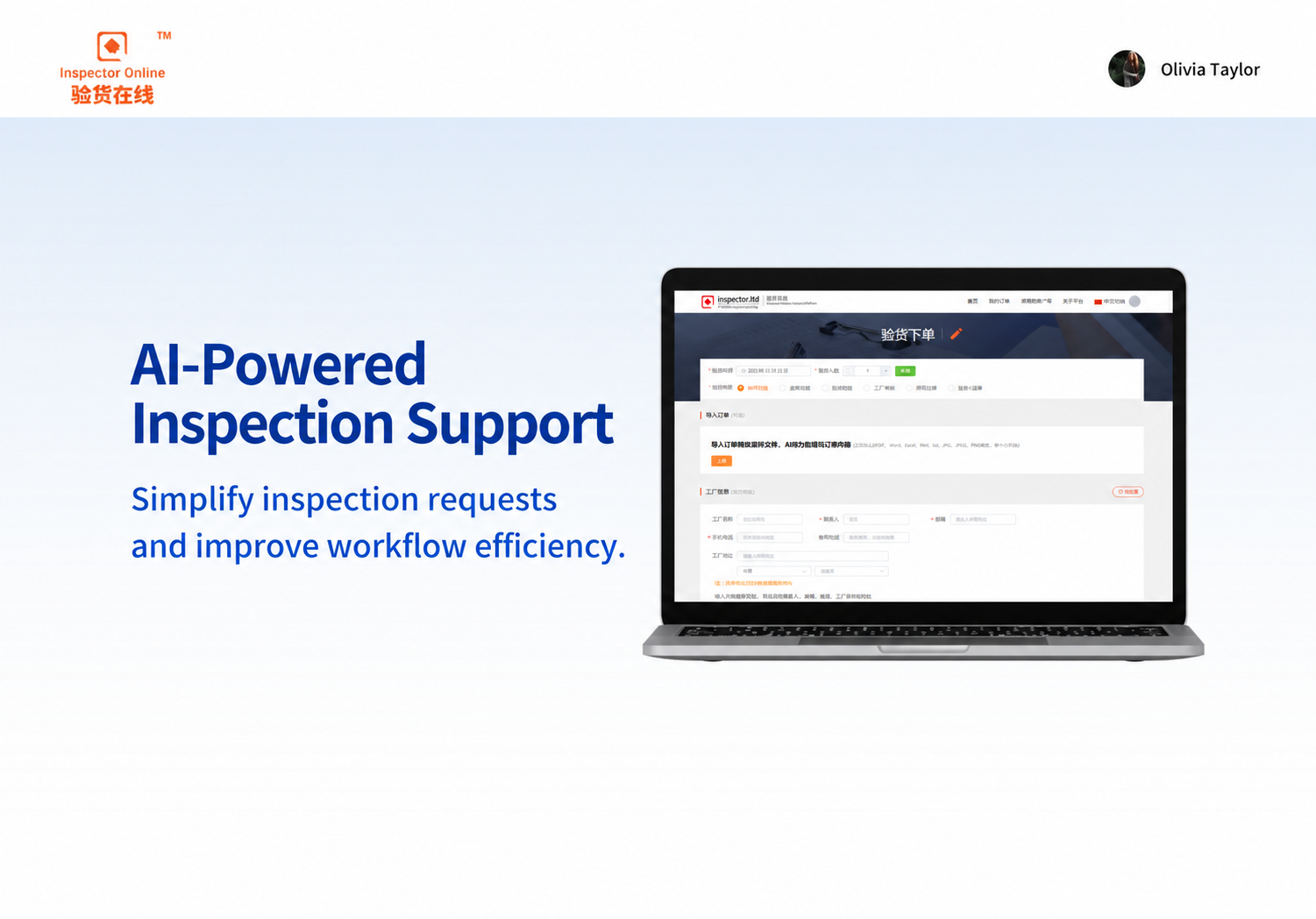
In addition, Inspection Online allows customers to place orders independently through the online platform, and the system automatically matches them with the nearest certified inspector, providing the dual benefits of “localized service” and “immediate response,” which significantly enhances service availability and flexibility.

Second, professional capacity and service system: is it throughout the whole cycle of quality control?
Cost-effectiveness is not only reflected in the price, but also in the depth of service. Low price but lack of professionalism in the inspection service, may miss the key defects, but lead to greater losses after the sale.
Inspection Online has constructed a perfect five-step quality control system covering:
Supplier audits (factory inspections)
Initial production inspection
Mid-production inspection
pre-shipment inspection
Container Supervisor (Container Supervisor)
This full-process closed-loop management ensures that every step of the process is under control, from source screening to shipment release. For example, during the initial inspection stage of production, the team verifies the compliance of raw materials and the consistency of the first sample to avoid the risk of large-scale rework caused by raw material substitution or process deviation in advance.
In contrast, some regional small organizations often only provide a single pre-shipment sampling services, can not be realized before the intervention, belong to the “mending” type of quality control, but in the long run, but pushed up the overall quality costs.
III. Speed of response and efficiency of delivery: time is cost
The pace of foreign trade orders is tight, sudden changes are frequent, and an efficient response mechanism is an important indicator of cost-effectiveness.
Goods Inspection Online promises fast response to orders within 30 minutes, priority treatment for urgent tasks, and delivery of inspection reports in as fast as 4 hours. Its global network of inspectors, together with its intelligent scheduling system, is capable of accomplishing multi-location synchronized inspection tasks, which is especially suitable for large-scale procurement projects with parallel production in multiple factories.
On the contrary, certain traditional organizations that rely on manual dispatching take more than 12 hours on average from order taking to dispatching, with a reported delivery cycle as long as 1-2 days, which seriously affects the rhythm of customers' shipping decisions. In time-sensitive industries such as fast fashion and consumer electronics, such delays can lead to chain losses such as shipment delays and inventory backlogs.
IV. Enabling technological innovation: how can intelligence enhance precision?
With the development of AI and big data technology, the leading third-party inspection service providers are transforming from “human-driven” to “technology-driven”. The online service platform independently developed by Inspection Online integrates a number of intelligent functions:
- AI-assisted Generation of Inspection Items: Automatically generate standardized inspection lists based on product categories and historical data to reduce human oversight.
- Intelligent Interpretation of Reports: Supports web-based viewing of electronic reports, and provides suggestions on defect classification and hints on the direction of rectification.
- Visualized tracking of the whole process: business leaders can view the progress of the inspector's tasks, photo uploads and communication records in real time to enhance transparency.
These technological innovations not only improve the accuracy of inspection, but also reduce operating costs, so that customers can obtain higher quality services at a more competitive price. Most small and medium-sized inspection companies have not yet established a digital system, still relying on paper forms and mail delivery, information is easy to lose and inefficient collaboration.

V. Pricing models and cost transparency: are there hidden fees?
Price is certainly the core factor affecting the cost-effectiveness, but the real “low price” should not be at the expense of service quality. Many low-priced service providers use fuzzy pricing methods, followed by additional transportation costs, overtime costs, report expediting fees, etc., and ultimately the actual expenditure far exceeds expectations.
Goods inspection online implementation of “free pricing + no hidden charges” mode, customers can set their own budget range on the platform, the system recommends the appropriate service program. All costs are open and transparent, including travel, the comprehensive cost of a one-time lock, eliminating late additions, and truly realize the cost of controllable.
In addition, its self-service ordering mechanism reduces the intermediate agent links, compressed channel costs, so that quality inspection services more inclusive, especially for small and medium-sized foreign trade enterprises and start-up brands to control quality control input.
Finally: cost-effective = professional + efficient + transparent + scalable
Choosing a cost-effective third-party inspection service provider can not only look at the offer high and low, but should be a comprehensive assessment of its global service capabilities, the whole process of quality control system, response efficiency, the level of technology application and price transparency. In the current highly competitive foreign trade environment, only such as goods inspection online (Beijing) Technology Co., Ltd. both professional precipitation and technological innovation capabilities of the platform, in order to truly achieve the “spend less, good control”.
If you would like to learn more about the definition of third-party inspection, common types of services, the basic process, and the procurement scenarios where third-party inspection services are appropriate, please refer to our Guide to Third-Party Inspection Services guide.
At the same time, enterprises can also refer to internationally renowned testing organizations when choosing, but for enterprises pursuing agility, flexibility and cost-effectiveInspector OnlineThe new digital inspection platform represented by the new digital inspection platform is undoubtedly a more adaptable and preferred solution.
Ultimately, an ideal partner is not only a quality inspection executive, but also a collaborator in supply chain risk management. Through scientific screening, enterprises can not only reduce the rate of quality accidents, but also enhance the stability and competitiveness of the entire supply chain, and win a lasting advantage in the global market.

 Chinese
  English