
Inspector Online is a third-party inspection and quality control service brand operated by Inspector Online (Beijing) Technology Co., Ltd. Since 2006, we have provided product inspection, factory audit, supplier assessment, and quality control services for international buyers, retailers, brands, and manufacturers.
Currently, Inspector Online has established a professional service network comprising more than 3,000 inspectors, with services covering all major regions of China and extending to more than 150 countries and regions, including South Korea, Japan, and Southeast Asia. Inspector Online (Beijing) Technology Co., Ltd. has provided product quality assurance support to more than 8,000 clients and partners worldwide.
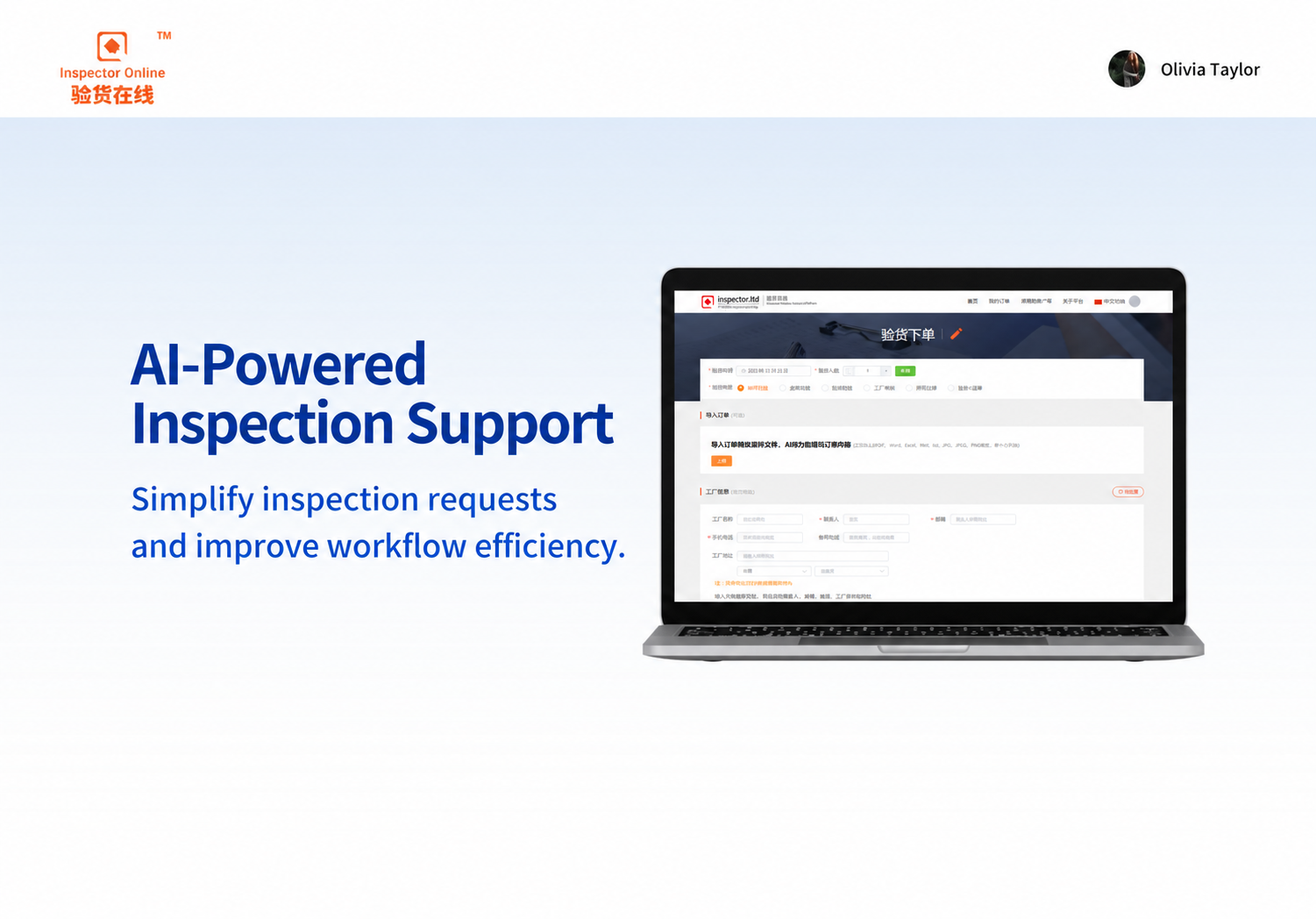
Inspection Online’s services cover product inspection, factory audits, loading supervision, quality inspection, and testing. Through its proprietary “Inspection Online Management System,” customers can place orders online, set their own prices, communicate in real time, and track service progress, thereby enhancing the efficiency and transparency of third-party quality control services.
Through digital technology, inspector matching, and real-time project tracking, Inspection Online provides clients with efficient and transparent third-party quality control services, while continuously enhancing global inspection and supply chain quality management capabilities.
Contact UsProfessional rigor, customer first. Honest and fair, innovative and enterprising.
To provide customers with professional, efficient and fair inspection and testing services, to protect product quality and promote the harmonious development of society.
To become a leader in the inspection and testing industry, to lead the industry with excellent service and innovation, and to create greater value for society.
Collaboration, excellence and continuous learning.
Verify product quality, workmanship, quantity, packaging, and labeling before shipment. Our independent inspectors help you identify potential issues and make informed shipping decisions.
Evaluate supplier capabilities, production facilities, quality management practices, and key business information before placing an order. Gain a clearer understanding of your supplier and potential sourcing risks.
Inspection Online is a professional third-party inspection inspection company, with a number of inspection centers, equipped with more than 5 years of experience QC, for domestic e-commerce, cross-border suppliers to provide clothing inspection, footwear inspection, Amazon FBA inspection and other services.
New "bounty-responsive" third-party sourcing, supplier referrals.
Identify potential product defects and reduce quality risks before shipment.
Detect issues early and provide inspection findings to support corrective action.
Check products against agreed specifications, quality standards, and inspection criteria.
Coordinate inspection schedules and provide timely updates to support your shipment plans.
Identify potential quality and supplier risks before they lead to costly problems.
Assess supplier capabilities and quality management practices to support sourcing decisions.
Prevent potential quality problems from occurring
Verify product quantities, packaging, and loading procedures against agreed requirements.
2896 man
32 country
65 kind
139 +
86 +
153085 +
3629 sky
79004 man

The hardware and tools category is diverse and involves numerous manufacturing processes, with quality risks concentrated in five areas: material, plating, dimensions, fit, and functionality. This article focuses on inspection tasks that can be performed on-site at factories and warehouses. It outlines the six major categories of hardware tools, six inspection requirements, seven on-site inspection methods, and five intervention points—pre-production, early production, mid-production, pre-shipment, and loading supervision—to provide the most cost-effective combination of inspections, helping buyers prevent batch defects before shipment.
A Comprehensive Guide to the Sneaker Inspection Process: This guide covers the seven-step inspection process—including sampling and counting, box label verification, packaging inspection, style verification, appearance and workmanship inspection, size measurement, and functional testing—and includes grading standards for common defects and AQL sampling methods to help international buyers mitigate quality risks before shipment.
A Comprehensive Guide to New Foreign Trade Regulations in October 2026: Microbial Testing of Recycled Pulp by Customs, EU Steel Smelting and Casting Country Declarations, the Final Implementation Period for CBAM, U.S. Polysilicon Tariffs, Indonesian Halal Certification, Vietnamese LED CR Certification, and More—Including Third-Party Inspection and Compliance Recommendations.
Why does the defect rate skyrocket during peak season rushes? This article breaks down the eight most common pitfalls in pre-shipment inspections (PSI), complete with a cost comparison chart between conducting and skipping inspections, AQL sampling standards, real-world inspection scenarios, and seven common questions—helping you prevent losses before your goods are loaded into containers.
Black Friday (November 27) and Cyber Monday (November 30) warehouse intake deadlines are fast approaching: AWD deadline is October 14, minimum split deadline is October 21, and optimized split deadline is October 28. Attached is a 10-item pre-shipment inspection checklist.
GPSR has been fully implemented, and EU enforcement will be strengthened in 2026. This article provides a detailed explanation of EU requirements regarding responsible economic operators, labeling, technical documentation, and more, as well as how third-party inspections can help you clear customs smoothly.
As a third-party inspection company with 20 years of experience in the field, Goods Inspection Online avoids the risks of under-inspection and omission, picture falsification and information distortion from the source, and creates real and accurate traceable inspection reports through the digitalization of the whole process, hard constraints on sampling, and retention of multiple controls such as the chain of evidence, so that we can keep a strict check on the quality of factories for you!
Inspection Online held the work deployment meeting in 2026, officially launched the self-developed APP report editing system, planned the new year's work mode, improved the efficiency of inspection report editing and service quality, strengthened teamwork and staff training, and promoted the company's high-quality development with the concept of win-win cooperation and innovation.
Inspection Online went to Zhejiang Jinhua Wuyi, Yongkang and other places to carry out on-site inspection from July 2 to 4 to implement the concept of "quality first" in the mode of "unannounced inspection + full-process verification", strictly control the quality of products such as garlic presses, gas stoves, etc., and optimize the inspection service to help foreign trade enterprises export their products. The inspection service is optimized to help foreign trade enterprises export their products.
Goods inspection online on June 24 to the local textile enterprises to carry out field inspection surprise inspection, "surprise inspection + full-process verification" mode to inspect the whole process of inspection, in-depth exchanges with factories to optimize services for textile products exported to build a solid quality line of defense, help "Made in China " to the world.
Goods Inspection Online appeared at the 137th Canton Fair, attracting many international customers and successfully expanding overseas markets with its professional goods inspection services. The company relies on a global team of inspectors and new AI technology to help the high-quality development of the foreign trade industry.
Goods inspection online to prepare for the Canton Fair, "hard work, unity, professionalism, service" as the core of the four spirit, selected backbone team, strengthen professional training, optimize the service process. The company is committed to become a long-term partner of customers on the road of foreign trade, through standardized inspection services, customized exhibition manuals and resource integration, to help customers stand out in the Canton Fair, and build a new ecosystem of foreign trade.
A Comprehensive Guide to New Foreign Trade Regulations in October 2026: Microbial Testing of Recycled Pulp by Customs, EU Steel Smelting and Casting Country Declarations, the Final Implementation Period for CBAM, U.S. Polysilicon Tariffs, Indonesian Halal Certification, Vietnamese LED CR Certification, and More—Including Third-Party Inspection and Compliance Recommendations.
Black Friday (November 27) and Cyber Monday (November 30) warehouse intake deadlines are fast approaching: AWD deadline is October 14, minimum split deadline is October 21, and optimized split deadline is October 28. Attached is a 10-item pre-shipment inspection checklist.
GPSR has been fully implemented, and EU enforcement will be strengthened in 2026. This article provides a detailed explanation of EU requirements regarding responsible economic operators, labeling, technical documentation, and more, as well as how third-party inspections can help you clear customs smoothly.
A summary of new domestic and international regulations on foreign trade and cross-border commerce effective in September 2026, covering topics such as electronic documentation, excise taxes on batteries, animal and plant quarantine, Vietnam’s Foreign Trade Management Law, and centralized management of cross-border funds.
Learn the latest EU CE certification requirements for 2026, including key regulatory updates, GPSR considerations, and a practical pre-shipment inspection checklist for exporters.
Learn what to do after a failed inspection, including the rework process, re-inspection steps, AQL sampling rules, timelines, and a practical checklist to help reduce delays and shipment risks.
In the first half of 2025, China's cross-border e-commerce in the South Korean market has achieved remarkable results, with 70.83 million pieces of directly purchased goods, ranking first in South Korea's e-trade imports with a share of 77%, an increase of about three times compared with that of 2021. Relying on perfect manufacturing industry, cost-effective products and efficient logistics, China's cross-border e-commerce is rapidly rising, but it also faces a trust crisis with an increase of 21% in trademark infringement cases, a 746-fold increase in hazardous substances in children's products, and an increase of 56% in the number of complaints. This paper analyzes the advantages of its development, focuses on quality control and consumer rights protection countermeasures, and helps China's cross-border e-commerce realize sustainable development in the Korean market.
The General Administration of Market Supervision launched the "strictest" regulation of rechargeable treasure, Romance, Anchor Innovation, millet cumulative recall of more than 1.35 million pieces of problematic products, refunds of more than 100 million yuan, the synchronization of the suspension of 9,000 3C certificates, off the shelves of 80,000 e-commerce links. The article analyzes the supply chain crisis of ROMANS and the cross-border compliance problem of Anker Innovation, exposes the "four-stream test" of consumer electronics going overseas, and puts forward the triple breakthrough path of "quality control + compliance + supply chain" in combination with experts' suggestions, which helps to understand the new ecology of industry regulation.
China's digital trade performance in the first half of the year was remarkable as the global economy was searching for an anchor! The import and export value of digitally deliverable services exceeded RMB 1.5 trillion yuan, and the import and export value of cross-border e-commerce reached RMB 1.3 trillion yuan, with the two core indicators hitting record highs. Digital trade reconstructs the trade process, hedges the fluctuation of traditional foreign trade, and builds a perfect ecosystem based on 5G, AI and other technologies, injecting kinetic energy into the high-quality development of China's foreign trade and providing certainty for the recovery of the global economy.
In September 2025, new foreign trade regulations at home and abroad were formally implemented! Domestic regulations involve cross-border e-commerce tax rebate declaration time limit, customs overseas warehouse record cancellation, etc.; foreign policies including U.S. auto drug tariffs, EU ICS2 system, Indian polyester staple fiber anti-dumping duty, etc. An article to read and understand the main points of the new regulations, help foreign trade enterprises to comply with the business!
2025 The Ministry of Commerce introduced a combination of policies to support foreign trade enterprises! Including China-European liner freight deduction, export credit insurance full-process protection, market access negative list optimization and other initiatives, covering logistics, risk, information, the whole chain, to help enterprises to reduce costs, risk prevention, market expansion, and promote the transformation of foreign trade to quality and efficiency.
China and India recently reached a 10-point consensus, fully restarted Rinchingang - Changgu and other three border trade ports, the resumption of direct flights interrupted for five years, and upgrading the border control mechanism. This move will not only drive South Tibet, Ali and other border areas to increase the income of herdsmen, it is expected that the per capita annual income of the border people increased by more than 3,000 yuan, but also to promote the "One Belt and One Road" and India's "Eastward Movement" policy docking, helping to increase the value of border trade in three years. 200%: Under the tariff game between China and the U.S. and changes in geopolitical patterns, China and India have opened a new chapter of mutual trust and cooperation in the mode of "Economy First, Security Follow-up", providing a new paradigm for South-South cooperation and global governance.
The hardware and tools category is diverse and involves numerous manufacturing processes, with quality risks concentrated in five areas: material, plating, dimensions, fit, and functionality. This article focuses on inspection tasks that can be performed on-site at factories and warehouses. It outlines the six major categories of hardware tools, six inspection requirements, seven on-site inspection methods, and five intervention points—pre-production, early production, mid-production, pre-shipment, and loading supervision—to provide the most cost-effective combination of inspections, helping buyers prevent batch defects before shipment.
Furniture Inspection Guide: Seven essential points that inspectors must check at factories and warehouses—including appearance and workmanship, moisture content, structural strength, hardware functionality, KD assembly and disassembly, packaging drop tests, and quantity and markings—along with a classification of common defects and an AQL sampling table to help you prevent return risks before shipment.
Is there a disconnect between IQC (Incoming Quality Control) and OQC (Outgoing Quality Control)? This article explains how the two can be seamlessly integrated through standardized AQL, defect codes, batch traceability, and 8D closed-loop processes, and details how third-party inspections can fill the gaps. It also includes a factory quality closed-loop checklist. Get a free inspection plan.
To determine whether a supplier’s factory is reliable, the key lies in examining 10 specific details during an on-site audit: the width of fire exits, equipment maintenance records, quality inspection procedures, worker conditions, warehouse management, and more. This article breaks down each item step by step according to the audit route and includes a checklist of compliance and risk indicators to help buyers identify problematic factories before placing orders.
A real-life apparel inspection case study. Before shipment, an inspector used standard lighting and a color difference meter to identify a batch-wide color discrepancy caused by dye lot variations, promptly intervening to prevent the entire batch from being returned. This article also outlines key methods for color assessment, color measurement, and sampling in apparel inspections.
Learn the key luggage inspection checks for wheels, handles, zippers, stitching, materials, AQL sampling and functional testing before shipment.
Third-party inspection and supplier audit services for importers, brands, retailers, and e-commerce businesses worldwide. With 3,000+ qualified inspectors covering 150+ countries and regions, Inspector Online helps you identify quality risks before shipment.
 Chinese Chinese
 English
