

This guidance document has been developed to ensure the rigor and compliance with standards of sampling inspections for multi-item orders. Its core objective is to ensure that:
- Standards compliance: The final sample size for each grade must be the number explicitly specified in the applicable sampling standard (such as ANSI/ASQ Z1.4).
- Overall coverage: The sum of the standard sample sizes for all varieties shall be equal to or slightly greater than the standard sample size required when the entire order is considered as a single whole.
- Statistical validity: Based on the total sample size after aggregation and its corresponding acceptance criteria in the standard, the whole shipment is scientifically determined.
I. Core logic
Instead of scaling and then rounding, the constructive logic of “assigning standard sample sizes to each species and summing them to the standard” is used.
Second, the operation process details
Step 1: Determine the overall target sample size
- Calculate Total Order Quantity (N): Aggregates the quantities of all varieties.
- Determine the “overall standard sample size (n_total)”:
Consider the entire order (quantity N) as a single lot.
Find the corresponding sample size character code and standardized sample size based on the general test level II in the standard (e.g., ANSI/ASQ Z1.4), which is `n_total`.
Example:
Total number of orders N = 500 (A) + 800 (B) + 700 (C) = 2000 pieces
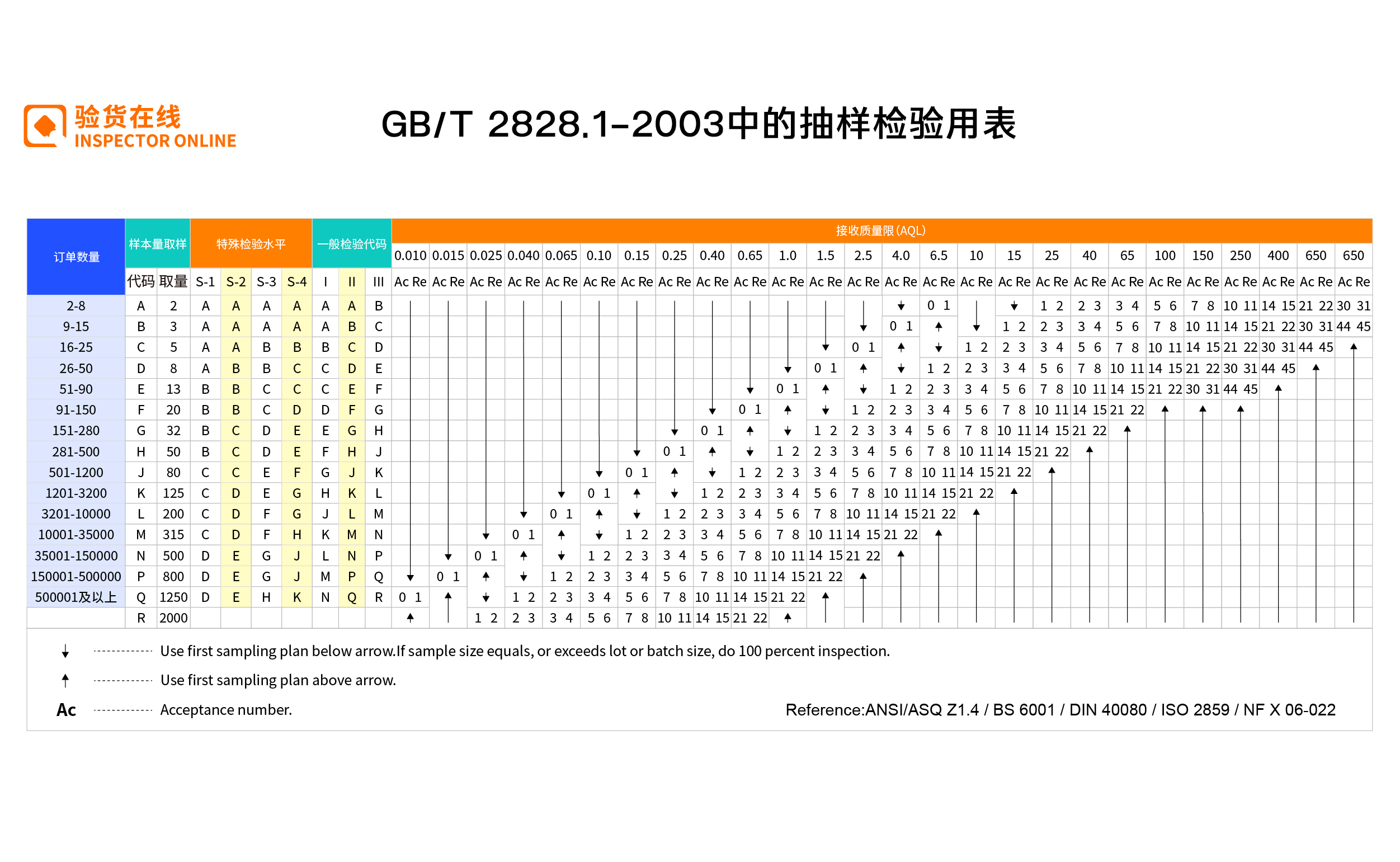
Look up the table (Level II, N = 2000) with the word code K, corresponding to the standard sample size n_total = 125.
Step 2: Initial allocation of standard sample sizes for each species
- Selection of initial test level: Select an initial test level for each variety (usually Level II for larger quantities and Level I for smaller quantities).
- Finding the standard sample size: Based on each variety's own number of `N_i` and the selected test level, find the sampling table to get its standard sample size.
Example (first attempt):
Product A (500 pieces): Adoption of level I → lookup table for code H → standard sample size 50
Product B (800 pieces): Adoption of level II → lookup table for code J → standard sample size 80
Product C (700 pieces): Adoption of level I → lookup table for code H → standard sample size 50
Initial total sample size Σn_initial = 50 + 80 + 50 = 180. (180 > 125, scheme is feasible but sample size is large, can be optimized)
Step 3: Fine-tuning and optimization (key step)
- Goal: Keep the total sample size as close to `n_total` as possible to avoid over-testing.
- Optimize the operation: Try to reduce the test level for varieties with larger sample sizes.
Example (optimization tuning):
Product B (800 pieces) is downgraded from Level II to Level I. Look up the table: N=800, Level I, character code I → Standard sample size is 50.
Optimized final solution:
Product A: 50 pieces (Level I)
Product B: 50 pieces (Level I)
Product C: 32 pcs (Level S-4, Code G)
Final total sample size = 50 + 50 + 32 = 132
Note: To more closely match your “32,50,50” example, Product C uses a special test level S-4 (N=700, S-4, code G, sample size 32).132 is slightly greater than 125, a standardized and very efficient solution.
Step 4: Perform Sampling and Overall Determination
Sampling to standards: A standard sample size of samples from each species is taken in strict accordance with the final program.
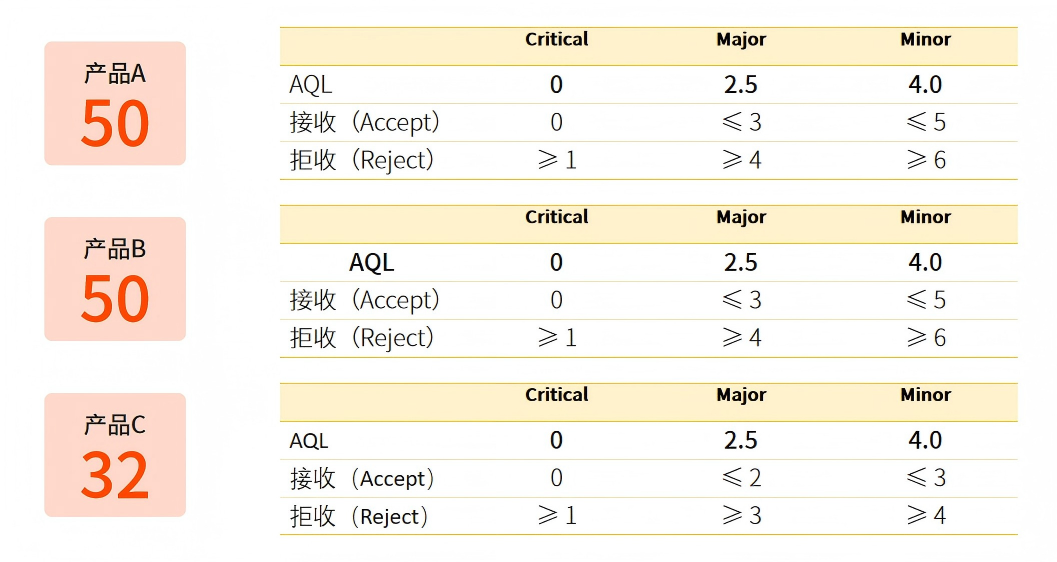
Sampling product A: 50 pieces
Sampling product B: 50 pieces
Sampling product C: 32 pieces
Determine the criteria for the determination:

Third, GB/T2828.1-2003 in the sampling test table

 Chinese
  English