

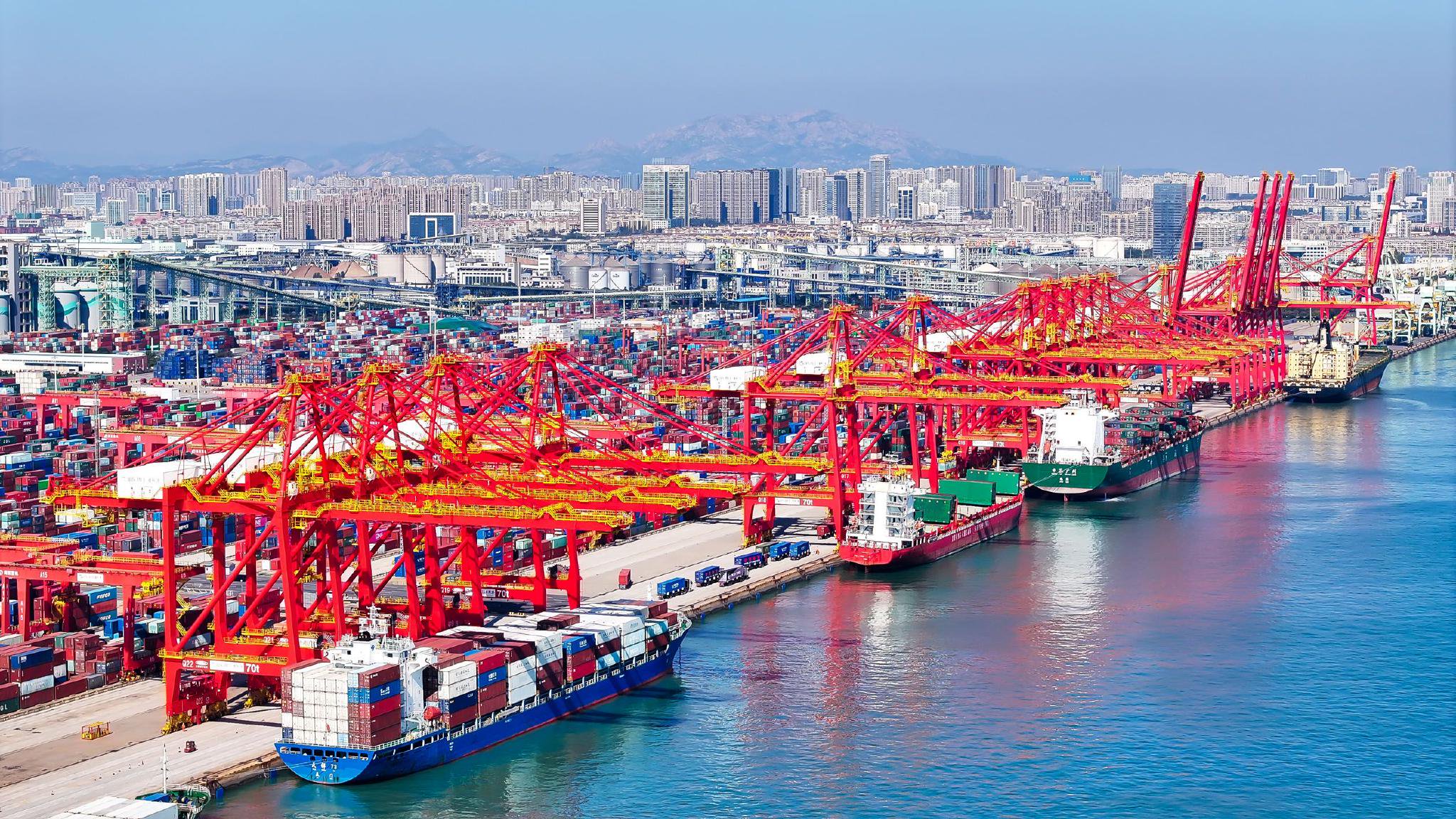

Beijing, May 23 (China News Service) (Reporters Men Rui, Wu Kan, Jin Xu) Several Chinese-American cross-border trade operators recently told China News Service reporters in online interviews that, following the mutual reduction of tariffs between China and the United States, U.S. companies have taken advantage of the window of opportunity to place large orders for Chinese goods, leading to booking pressure and signs of saturation in the ocean freight and warehousing sectors.
Mingming Wang, executive director of the US-China E-Commerce Trade Association, said that after China and the US lowered tariffs, the backlog of orders from traditional US superstore customers began to resume shipments. According to her, the cross-border shipping business is now seeing a wave of high tide. "A large number of bookings by customers have led to price hikes for U.S.-line shipping vessels."
Zhao Bingrong, a Chinese-American businessman, told reporters that some projects had originally planned to import equipment and materials from China, but the process was temporarily suspended after the U.S. imposed excessive tariffs. With the significant reduction in tariffs between China and the U.S., these projects have resumed, and many overseas Chinese businesspeople engaged in import-export trade have gradually resumed their operations.
Luo Hao, president of the U.S. E-Commerce Logistics Federation, told reporters that many U.S. companies have recently increased the procurement of medical products, health care raw materials and other supplies from China, and purchases have generally reached more than six months of reserve requirements. "U.S. customers seize the time to replenish inventory, and in recent weeks, with the increase in the volume of goods from China, our warehouse utilization rate is close to saturation."
Wang Mingming also said that under the influence of previous tariff policies, small and medium-sized merchants on the U.S. e-commerce platform once faced shortages and out-of-stock phenomenon. Considering the risk of freight transportation cycle and policy changes, the shortage of raw materials and commodities in the U.S. market and price increases may continue for a period of time, and the U.S. market supply chain operation and consumption may continue to face challenges.

 Chinese
  English
  Japanese
  Korean
  Indonesian
  German